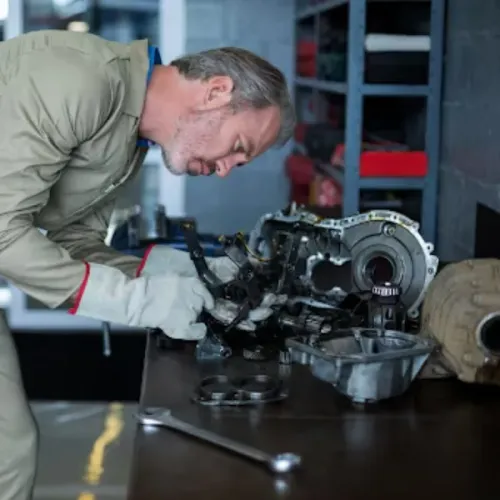
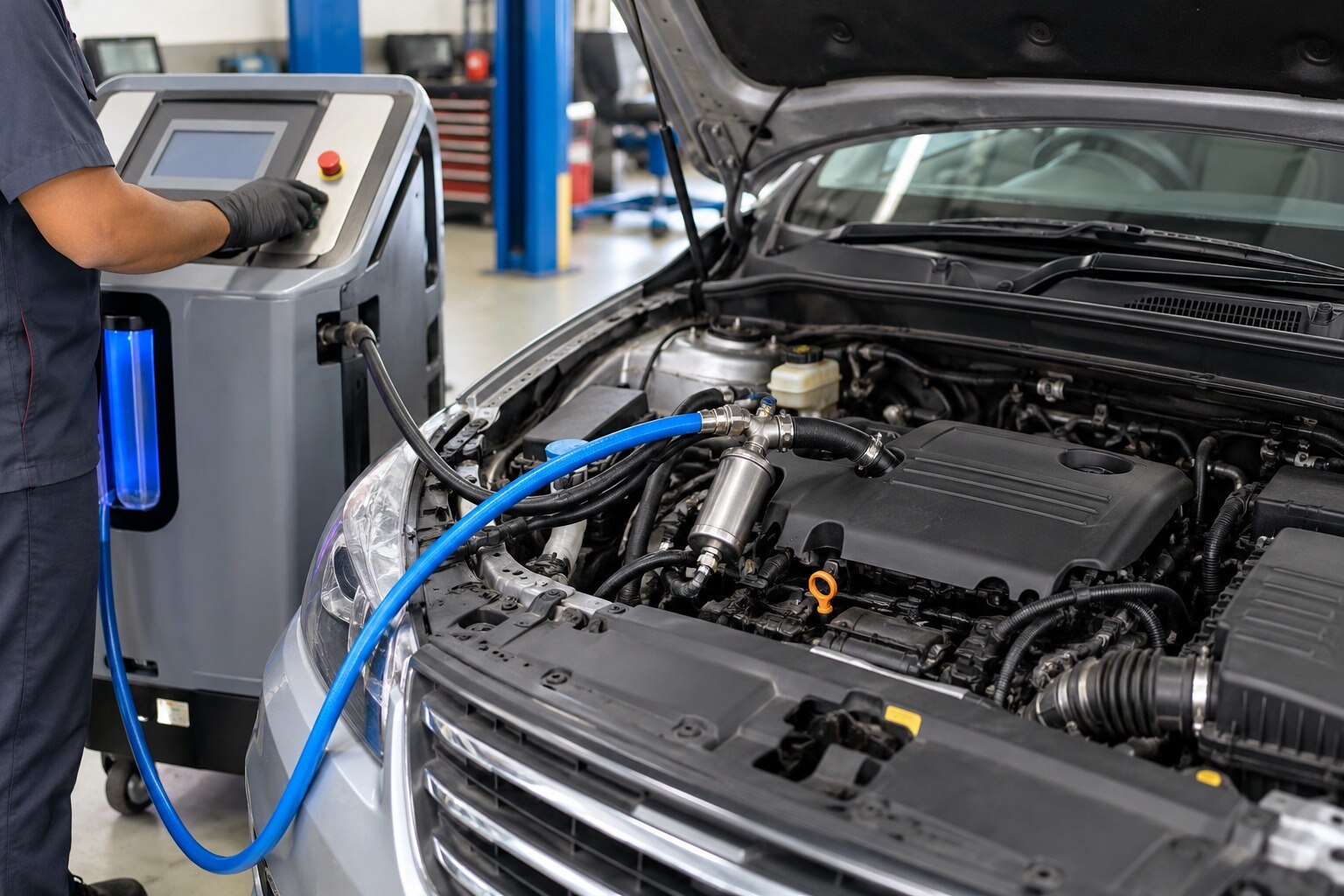
Reduced power, hesitation, rough running and poor fuel economy do not prove that carbon deposits are responsible. By the end, you will know where deposits form, which tests can confirm them, which cleaning method fits the engine, and when another repair must come first.
Key takeaways
- Confirm carbon deposits before paying for an engine cleaning service.
- Separate carbon-build-up symptoms from faults in ignition, fuel, sensors, or compression.
- Compare cleaning methods by the deposits they remove and the parts they reach.
- Treat unchanged performance as a reason to investigate another fault.
Where carbon deposits form—and why engine design changes the answer
Carbon deposits collect on intake valves, in combustion chambers, on piston crowns, around fuel injectors, and through exhaust-gas recirculation passages. Turbochargers can also accumulate soot and oil residue, while diesel particulate filter systems trap ash and soot rather than loose carbon alone.
Engine design changes both the deposit location and the cleaning method:
| Engine design | Where deposits build | Why it changes the answer |
|---|---|---|
| Petrol direct-injection | Intake valves, combustion chambers, piston crowns and injectors | Petrol bypasses the intake valves, so crankcase oil mist, EGR and blow-by can bake onto their backs. Fuel additives cannot directly wash them clean. |
| Petrol port-injection | Injectors, combustion chambers and intake valves | Fuel sprays upstream of the valves and can help keep them cleaner. Severe baked-on deposits still need mechanical cleaning. |
| Diesel | Injectors, piston crowns, combustion chambers, EGR passages, turbocharger and DPF | Soot, oil vapour and high exhaust recirculation load the intake and exhaust systems. A restricted DPF needs its own diagnosis. |
| Turbocharged | Intake tract, intercooler, EGR system and turbocharger | Boosted engines move more air and oil mist; a failed turbo seal can create oil contamination that cleaning will not fix. |
| Naturally aspirated or hybrid | Combustion chambers and intake system; hybrids add low-temperature, stop-start running | Hybrids can spend long periods with the engine off, then run briefly under load, giving deposits less opportunity to burn away. |
A combustion-chamber deposit can reduce chamber volume, create hot spots, raise octane demand and contribute to knock. That does not prove carbon caused reduced power: fault codes, airflow data and inspection must identify the actual restriction or deposit.
Symptoms that fit carbon build-up—and symptoms pointing elsewhere
Rough idle, hesitation under acceleration, reduced power and hard starting can fit carbon build-up, especially when they developed gradually and occur with misfires, poor fuel economy or engine knock. Intake-valve deposits disturb incoming airflow; combustion-chamber deposits create hot spots and can raise the engine’s octane requirement.
| Symptom | Deposit-related clue | Common alternatives |
|---|---|---|
| Rough idle | Uneven airflow or deposit-related misfire | Vacuum leak, dirty throttle body, weak ignition coil, faulty injector |
| Hesitation under acceleration | Restricted intake flow or disturbed air pattern | Low fuel pressure, clogged filter, failing MAF or MAP sensor, turbocharger fault |
| Reduced power | Severe intake restriction or abnormal combustion | Limp mode, blocked diesel particulate filter, restricted catalytic converter, boost leak |
| Hard starting | Deposits combined with misfire or poor combustion | Weak battery, crankshaft sensor, low compression, injector fault, incorrect fuel pressure |
| Knock or pinging | Hot spots or increased octane requirement | Low-octane fuel, excessive ignition advance, overheating, cooling-system fault |
| Smoke or warning light | Deposit-related EGR or combustion irregularity | Oil burning, coolant leak, injector fault, DPF loading, oxygen-sensor failure |
A warning light or a subjective feeling of sluggishness does not identify carbon as the cause. Treat reduced-power or limp-home mode as a diagnosis problem first: fault codes and live data must rule out air, fuel, ignition, compression, turbocharger and exhaust faults before cleaning is chosen.
A borescope image provides stronger evidence than a symptom-based sales claim.
How to confirm deposits before choosing a cleaning service
Do not approve a cleaning service from sluggishness alone. Read diagnostic trouble codes and live data first, then match the result to a physical inspection. Reduced-power or limp-home mode needs this diagnosis before any decarbonisation treatment.
| Fault area | Evidence pointing to another fault | Evidence supporting deposits |
|---|---|---|
| Air | Unmetered-air readings, a split intake hose, boost leakage, or abnormal mass-airflow data | Restricted airflow with no leak, plus intake inspection showing contamination |
| Ignition | A cylinder-specific misfire, worn spark plug, failed coil, or ignition waveform fault | Misfires that track airflow or deposit findings rather than one failed ignition part |
| Fuel | Low fuel pressure, injector balance failure, or poor spray pattern | Injector data is normal, but deposits are visible near the injector or intake path |
| Compression | Low compression that stays low during a wet test, or leak-down air escaping through rings or valves | Uneven compression with chamber deposits visible and no major leak-down loss |
| Sensor or emissions | Failed oxygen, pressure, temperature, EGR, turbocharger, catalytic converter, or diesel particulate filter test | Airflow-related codes and readings align with confirmed intake deposits |
Use borescope inspection to view piston crowns and, where access permits, intake valves; a normal compression test does not rule out valve deposits. Intake inspection can reveal oily sludge or restricted passages, but it cannot prove how much material sits inside each cylinder.
Compression testing identifies sealing problems, not every deposit. Ask for photographs, cylinder-specific results, injector measurements, and the fault-code report. If low compression remains after a clean test, request a leak-down test: worn rings, a burnt valve, or a head-gasket failure needs repair, not decarbonisation.
Choosing a cleaning method and knowing what the service includes
A method is only useful if it reaches the deposit causing the fault. Intake cleaning through a vacuum line will not remove a thick valve deposit, while fuel-system cleaning targets injectors rather than the backs of intake valves.
| Option | What it means | When it applies |
|---|---|---|
| Intake cleaning | Cleans the throttle body, manifold or EGR path; access depends on disassembly | Use when inspection finds dirt or restriction in those parts |
| Walnut-shell blasting | Uses contained walnut-shell blasting on exposed intake valves | Best for substantial baked-on deposits on direct-injection valve backs |
| Chemical cleaning | Solvent or detergent treatment through the intake, fuel system or cylinders | Suits light deposits; it is not an inspection or guaranteed blockage removal |
| Fuel-system cleaning | Additive or machine treatment for injectors and fuel rails | More relevant to injector deposits than direct-injection valve deposits |
| Hydrogen-based cleaning | Feeds hydrogen or oxyhydrogen gas into the intake | Treat as an uncertain supplement, not a substitute for valve inspection |
| Manual removal | Removes parts and scrapes or brushes deposits under direct inspection | Use for heavy, accessible restriction or deposits that other methods cannot shift |
Before work, the technician should record fault codes, fuel trims, misfire counts and symptoms, then use a borescope or inspection to identify the target. Ask whether the manifold, EGR valve and throttle body will be removed.
Afterward, ports must be vacuumed, parts checked for debris, adaptations completed where specified, and the same measurements repeated during a controlled road test. Auto Solutions should provide those before-and-after findings, not just a smoother idle claim.
When decarbonisation is the wrong first step—and how to judge the result
A car that has entered reduced-power or limp-home mode needs fault-code and live-data diagnosis before any cleaning service. A chemical treatment cannot repair worn piston rings, burnt valves, a failed head gasket, low fuel pressure, injector faults, ignition faults, or restricted exhaust systems.
| Fault or evidence | Separate action | Why cleaning cannot substitute |
|---|---|---|
| Low compression or high leak-down | Perform a leak-down test and repair rings, valves, or gasket faults | Cleaning will not restore damaged mechanical parts |
| High DPF soot or ash loading | Use manufacturer-approved regeneration; remove, clean, or replace the filter when specified | Ash does not burn off during normal regeneration |
| Incorrect boost or actuator faults | Test hoses, sensors, wastegate or variable-geometry turbocharger components | Deposits are not proof of a turbocharger failure |
| Blocked exhaust gas recirculation passages | Inspect and clean the EGR system using the vehicle maker’s procedure | An intake treatment may not reach the blockage |
| Fuel-pressure, injector, or ignition faults | Test pressure, injector performance, plugs, coils, and wiring | Cleaning cannot correct a failed component |
Judge the result against recorded baseline data, not a smoother test drive alone. Compare the same cold-start and road-test conditions:
- Diagnostic trouble codes, misfire counts, fuel trims, airflow, and boost against target values
- Idle speed stability, starting time, smoke, and fuel consumption
- Compression and leak-down results when chamber deposits were suspected
- DPF differential pressure and regeneration status for diesel particulate filter systems
Repeat the checks after several normal drives. A lasting improvement means the original fault data stays improved and the warning light does not return.
Frequently asked questions
Where do carbon deposits form in a car engine?
Deposits can form on intake valves, combustion chambers, piston crowns, fuel injectors, EGR passages, turbochargers, and diesel exhaust systems.
Which symptoms point to carbon build-up?
Poor acceleration, rough running, reduced fuel economy, difficult starting, and restricted airflow can fit carbon build-up, but they also occur with ignition, fuel, sensor, or compression faults.
How can you confirm carbon deposits before cleaning?
Ask for diagnostic scan results and a physical inspection, such as borescope images or intake-valve evidence, before choosing a cleaning service.
When is engine decarbonisation the wrong first step?
Investigate ignition, fuel delivery, sensors, compression, turbocharger faults, and exhaust restrictions first when the symptoms or test results point to those causes.