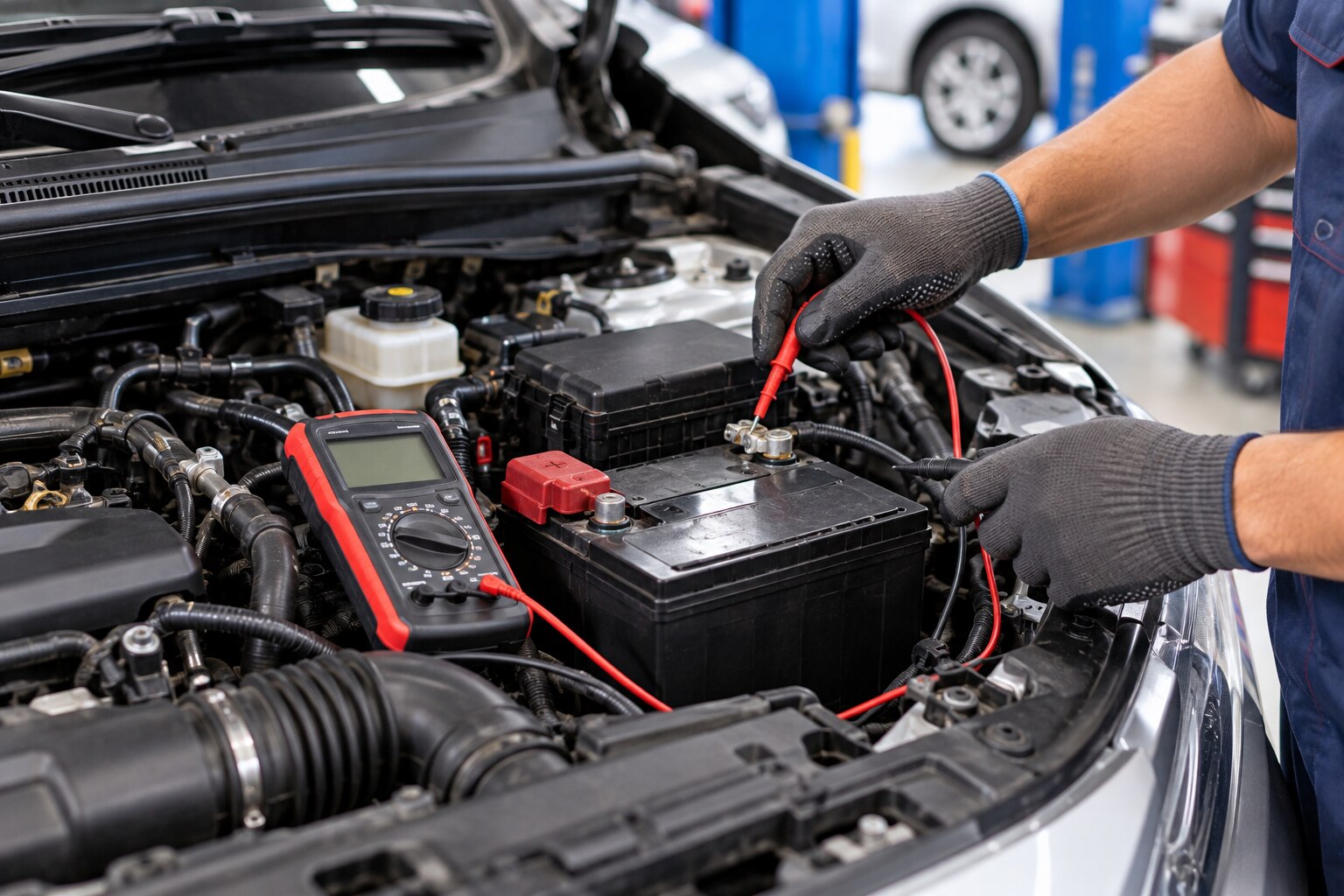
A slow crank, repeated clicking, dimming lights, or a reset clock points to a starting or charging fault, but the battery is not always the culprit. By checking the battery, cables, starter, alternator, and electrical load in the right order, you can decide whether cleaning, recharging, or replacement is justified.
Key takeaways
- Test battery voltage, cranking performance and charging-system output.
- Inspect battery terminals, earth straps and cables for looseness or corrosion.
- Recharge a discharged battery only after finding why it lost charge.
- Replace the battery when testing confirms low capacity or a failed cell.
Which Slow-Starting Symptoms Point to a Weak Battery?
A slow engine crank is evidence of a starting-system problem, not proof that the battery has failed. A sluggish starter motor, delayed cranking, repeated clicking, or dim dashboard lights point to low battery capacity, discharged cells, or poor terminal and earth connections.
If the engine starts after a jump-start, the battery was too weak at that moment—but one successful jump-start does not prove it is healthy.
| Symptom | What it suggests | What to do |
|---|---|---|
| Sluggish starter motor or delayed cranking | Low starting current, high cable resistance, or a worn starter | Arrange a battery and starting-system test |
| Repeated clicking with little or no crank | Voltage collapsing under load or a poor connection | Check terminals, earth cable, and battery condition |
| Flickering lights, slow power windows, infotainment or clock resets | Unstable system voltage or insufficient battery reserve | Check battery, charging output, and connections |
| Warning lights or accessories cutting out with the engine off | Low voltage or a battery unable to support electrical loads | Stop relying on repeated jump-starts and arrange testing |
Cold weather can expose a marginal battery because it reduces available starting power while thicker oil makes the engine harder to turn. A proper check measures terminal voltage drop, cable and ground resistance, starter current draw, alternator output, and parasitic current after the vehicle enters sleep mode.
Measuring immediately after locking the car can show a falsely high drain.
Arrange a test if the car needs more than one jump-start, goes flat again after driving, or shows several electrical symptoms together. A fully charged battery can still fail a load or conductance test.
How Can You Tell a Battery Fault from an Alternator, Starter, or Cable Problem?
A vehicle that starts after a jump but soon goes flat has more than one possible cause: a faulty alternator, loose earth cable, corroded battery terminals, or a parasitic electrical load can all leave a healthy battery discharged.
| Symptom | More likely direction | Next check |
|---|---|---|
| Single click with bright lights | Starter solenoid or worn starter motor | Starter current draw and connections |
| No response at all | Blown fuse, ignition-switch fault, immobiliser, or poor ground | Fuses, scan data, and ground resistance |
| Normal-speed cranking without starting | Fuel delivery, spark, or ignition control | Fuel pressure, ignition, and fault codes |
| Slow cranking with dimming lights | Low battery charge or high cable resistance | Voltage drop and battery test |
A slow crank proves a starting-system problem, not a failed battery. Test the whole circuit in this order:
- Measure battery-terminal voltage drop while the starter operates; excessive loss identifies a poor connection.
- Measure positive-cable and ground resistance, then inspect for a loose earth cable, damaged wiring, or corroded battery terminals.
- Check starter current draw; excessive demand points toward a worn starter motor.
- Test alternator output, charging current, and system behaviour under the vehicle maker’s procedure. Smart-charging systems vary voltage with temperature, battery state, load, and deceleration.
- Measure parasitic current only after the vehicle locks and its control modules enter sleep mode.
Testing immediately after locking a modern vehicle can show a falsely high draw. If the battery repeatedly goes flat while charging and starting tests pass, investigate a boot light, aftermarket accessory, relay, or control module.
What Does a Proper Car Battery Check Measure?
One voltage reading cannot prove that a battery is healthy. A technician starts by checking for a swollen case, cracked casing, leaking electrolyte, white or green terminal corrosion, loose clamps, damaged cables, and a battery that is not secure in its tray.
1. After cleaning the terminals and isolating surface charge, measure resting voltage with the fully charged battery switched off and rested. A 12-volt lead-acid battery normally reads 12.6–12.8 volts; 12.4 volts indicates about 75% charge, 12.2 volts about 50%, and 12.0 volts about 25%.
A reading taken immediately after driving or charging can be falsely high.
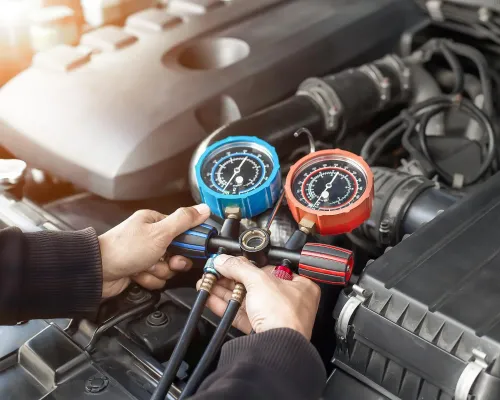
2. Perform a cranking-voltage test while the starter operates. It shows how far voltage falls under starting demand, which a resting-voltage reading cannot reveal.
3. Perform a load test when appropriate. A conventional test applies half the battery’s cold-cranking-ampere rating for 15 seconds; at about 21°C, voltage should remain at least 9.6 volts. Cold temperatures require the tester’s specified correction.
4. Perform a conductance test to estimate internal resistance and available capacity. A battery can show 12.6 volts yet fail because its plates have deteriorated.
The charging-system test measures alternator voltage, current, and behaviour with the engine running under the vehicle maker’s procedure. Smart-charging systems vary output with battery state, temperature, engine load, and deceleration, so one fixed alternator-voltage target is unreliable.
What Conditions Make a Battery Go Weak or Fail to Start?
Cold weather battery performance falls because a lead-acid battery delivers less starting power at low temperatures, while thicker engine oil makes the engine harder to crank. A battery that starts normally in warm weather can fail during the first cold snap.
Short trips and prolonged idling may not replace the energy used during starting. Headlights, heated glass, blower motors, and seat heaters increase the deficit, leaving the battery progressively undercharged.
Long parking periods allow self-discharge and reveal weaknesses that daily driving had concealed. A healthy battery can also go flat because of parasitic current from a glovebox light, aftermarket accessory, faulty relay, or control module.
- Ask whether the vehicle repeatedly goes flat, rather than treating one flat morning as proof of battery failure.
- Check whether it sat unused for weeks. Self-discharge and a small electrical load become significant during extended storage.
- Recharge it with a suitable external charger, then test it again. Recovery after charging points to undercharging; poor capacity after charging points to sulfation or internal damage.
- Before a parasitic-draw test, confirm that the vehicle is locked and the battery-management system and other control modules have entered sleep mode. Measuring immediately after locking can produce a falsely high reading.
Heat, vibration, deep discharge, charging faults, and repeated short trips shorten service life. Three to five years is a prompt to test the battery, not an automatic replacement rule.
When Should You Recharge, Clean, or Replace the Battery?
Recharge or repair the battery when it has low state of charge but acceptable capacity. Replace it when testing shows that charging cannot restore its starting performance or when physical damage makes it unsafe.
| Action | Choose it when | What to do next |
|---|---|---|
| Terminal cleaning or cable repair | White or green corrosion, loose clamps, or damaged cables are present | Perform terminal cleaning, tighten the clamps, and repair or replace damaged cables |
| Battery recharge | Capacity is acceptable but the state of charge is low | Use a suitable external charger, then re-test the fully charged battery |
| Battery replacement | The case is swollen, cracked, or leaking; the battery cannot be secured; or testing shows poor capacity | Install the correct specification and complete any required vehicle reset |
A battery that repeatedly goes flat needs a parasitic-draw and alternator check before replacement. If those faults are excluded and conductance or load testing still shows poor capacity after a battery recharge, choose battery replacement.
Match the vehicle maker’s specified case size, terminal layout, technology, minimum CCA, and reserve capacity. An automatic stop-start vehicle may require an EFB battery or AGM battery instead of a standard flooded battery. The wrong type can shorten service life and disable stop-start operation.
Many modern vehicles need battery registration or adaptation after installation, plus coding when battery type or capacity changes. Auto Solutions can combine battery, starter, cable, charging, and vehicle-specific battery-management checks so a weak symptom does not lead to an unnecessary part replacement.
Frequently asked questions
Which slow-starting symptoms point to a weak battery?
Slow cranking, repeated clicking, delayed starting and dim dashboard lights point to low battery capacity, discharged cells or poor connections.
How can you tell a battery fault from an alternator, starter or cable problem?
Compare battery voltage, cranking performance, charging-system output and the condition of the starter circuit, terminals, cables and earth straps.
What does a proper car battery check measure?
A proper check measures resting voltage, voltage during cranking, battery capacity or conductance, charging voltage and terminal or earth-connection condition.
When should you recharge, clean or replace the battery?
Recharge a discharged battery after checking its cause, clean safe-to-handle corrosion and tighten connections, and replace the battery when testing confirms failed capacity or a bad cell.