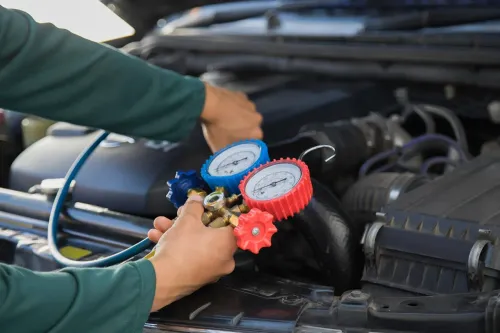

Weak cooling does not automatically mean the refrigerant is low: a clogged filter, failed condenser fan, evaporator icing, actuator fault, or electrical problem can create the same complaint. By the end, you will know which observations you can make safely, what a proper AC checkup should test, and when topping up refrigerant is the wrong next step.
Key takeaways
- Weak cooling at every fan speed can indicate a leak, compressor fault, or restriction.
- Weak airflow points to the cabin filter, blower motor, vents, or evaporator blockage.
- A proper AC checkup measures vent temperature, pressures, airflow, leaks, and compressor operation.
- A refrigerant top-up is temporary if a leak remains unrepaired.
Match the cooling symptom to the likely fault
Weak cooling at every speed points toward low refrigerant from a leak, a weak compressor, or a restriction in the expansion valve. The pattern matters more than a single pressure reading.
| Pattern | Likely fault | Why it points there |
|---|---|---|
| Weak cooling at all speeds | Refrigerant loss or compressor fault | Low charge reduces evaporator cooling; a worn compressor cannot build the required pressure difference. |
| Cooling fades at idle | Condenser airflow failure | A failed electric fan, blocked condenser, or obstruction removes the airflow that stationary operation needs. |
| Cooling improves only while driving | Condenser airflow restriction | Road speed supplies airflow that the fan should provide at a standstill. |
| Weak airflow with cold air | Cabin filter, blower motor, or evaporator restriction | The refrigerant circuit may be cold while debris, ice, or a weak blower limits air volume. |
| Strong cooling that fades after several minutes | Evaporator icing or temperature-control fault | Ice blocks airflow and can make a good compressor appear faulty. |
| Intermittent AC operation | Electrical control, relay, pressure sensor, or compressor-clutch fault | A failing command or safety cut-off can stop cooling and restore it later. |
| One vent warm or left-right temperatures differ | Blend-door actuator or door-position fault | The system may produce cold air, but the HVAC door routes it incorrectly. |
Refrigerant is not consumed during normal operation, so recurring weak cooling requires leak detection rather than repeated top-ups. An AC checkup should test vent temperature, airflow, fan operation, compressor engagement, electrical controls, and leaks; pressure alone cannot prove the charge is correct.
Use the symptom pattern to separate airflow from temperature problems
Air volume tells you whether the fault is airflow or cooling. Weak airflow with cold air points to a clogged cabin air filter, blocked evaporator face, or failed blower motor—not automatically low refrigerant.
A blower that works only on some speeds suggests its resistor or electronic control; no airflow at any speed points toward the motor, fuse, relay, or wiring.
Use the timing and outlet pattern as clues:
- Strong cooling that fades after several minutes, with airflow shrinking, suggests evaporator icing. Ice blocks the air path; check evaporator temperature sensing and compressor control.
- Warm air from one vent points to a blend-door or air-mix actuator fault. The evaporator can be cold while the door routes air around it.
- Uneven left-right temperature suggests a blend-door problem, blocked duct, or dual-zone actuator issue. Low refrigerant more often reduces cooling across several outlets.
- Cooling that improves while driving but fades at idle points to poor condenser airflow, such as a failed electric fan or blocked condenser, rather than proving low charge.
- Foul smells point to a dirty cabin filter, damp evaporator, or microbial growth. They do not establish refrigerant loss.
If every outlet delivers warm air and airflow remains strong, check refrigerant charge, compressor operation, condenser airflow, and expansion control. Pressure readings alone cannot prove the charge: ambient temperature, engine speed, refrigerant type, and fan operation change the readings. A measured recovery, evacuation, and manufacturer-specified recharge gives a more reliable answer.
What a proper car AC checkup actually measures
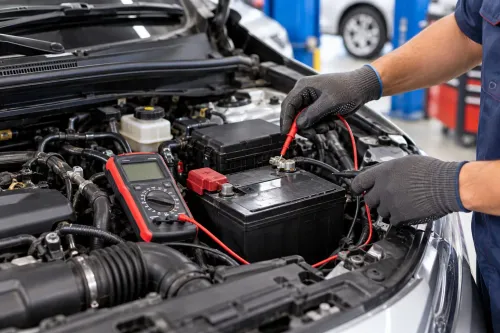
A vent-temperature measurement is meaningful only when outside temperature, humidity, blower setting, recirculation, engine speed, and probe location are recorded. Pair it with an airflow assessment and compare both results with the vehicle’s specifications. Cold air with weak airflow points to a different fault than warm air with normal airflow.
Refrigerant-pressure testing helps assess operation, not charge by itself. Pressure changes with ambient temperature, compressor speed, condenser airflow, refrigerant type, and control strategy. Correct charge requires recovery, evacuation, and charging by the manufacturer-specified mass.
A complete check includes these physical and control inspections:
- Compressor inspection covers clutch or control-valve operation, belt condition, abnormal noise, shaft-seal leakage, and commanded versus actual operation.
- Inspect the condenser for blocked fins, impact damage, corrosion, and poor fan operation.
- Test expansion-valve operation through temperature and pressure changes across the evaporator.
- Check fuses, relays, wiring, sensors, and scan-tool fault codes.
- Check HVAC actuator position, calibration, and movement; a failed blend door can route cabin air around a cold evaporator.
| Check | What it establishes | Limitation |
|---|---|---|
| Electronic leak detector | Refrigerant escaping near accessible components | Airflow can dilute the refrigerant |
| Ultraviolet dye | Dye at hose crimps, seals, or drain area | It must circulate before detection |
| Inert-gas pressure test | Leaks revealed while the system is pressurised | A vibration- or temperature-dependent leak can remain hidden |
| Evaporator-temperature check | Icing or faulty temperature control | It does not locate a refrigerant leak |
Why refrigerant top-up is not the same as repair
Recurring weak cooling means the refrigerant charge is escaping, not being “used up.” Repeated top-ups hide the refrigerant leak, restore cooling only temporarily, and can leave the compressor short of circulating oil, increasing the risk of damage.
- Recover the remaining refrigerant and record its mass. Use a refrigerant identifier first: R-134a and R-1234yf are not interchangeable, and each requires matching oil, fittings, recovery equipment, and charging procedure.
- Inspect the condenser, hose crimps, compressor shaft seal, service ports, evaporator drain area, and accessible pipe joints for an oily residue. Oil often marks where refrigerant has carried lubricant out, but a clean surface does not prove that it is leak-free.
- Evacuate the system, confirm it holds vacuum, and recharge it by the vehicle maker’s specified mass. Pressure readings alone cannot establish charge because pressure changes with ambient temperature, compressor speed, condenser airflow, refrigerant type, and control strategy.
| Leak-test method | What it reveals | Main limitation |
|---|---|---|
| Electronic leak detector | Refrigerant concentration escaping at joints, seals, and the evaporator drain | Airflow can dilute the gas, and vibration or temperature changes can hide an intermittent leak |
| Ultraviolet dye | Dye carried with refrigerant and oil to a visible leak point under UV light | It cannot identify a leak before the dye circulates through the system |
| Inert-gas pressure test | Pressure loss from a sealed system, including leaks too small for immediate visual evidence | It may miss a fault that opens only during operation, vibration, or temperature change |
A technician may need more than one method. Adding gas without finding the source is refilling a leak, not repairing the air conditioner.
Know what you can check safely and when to book service
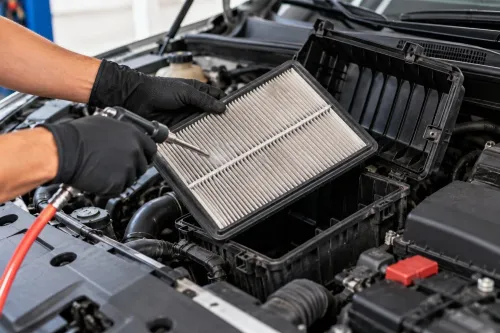
Before booking, safely inspect the cabin air filter, visible leaves or mud causing blocked condenser airflow, the drive belt, and vent operation in recirculation mode. Do not loosen refrigerant fittings or probe pressurised lines. A dirty filter restricts air; it cannot fix warm refrigerant or a failed blower.
- Stop using the air conditioner and arrange prompt service for an electrical burning smell, smoke, a sharp belt squeal, or a compressor that locks and throws the belt.
- Book diagnosis soon if cooling fades after several minutes, works only while driving, blows warm from one side, or repeatedly cycles off.
- Ask for recorded vent temperature, airflow, pressure, condenser-fan operation, fuse and relay checks, and scan-tool checks rather than a pressure reading alone.
| Service | What it means | When it applies |
|---|---|---|
| AC checkup | Measures airflow, temperatures, controls, compressor operation, and leak evidence under stated conditions | The cause is unknown |
| Filter cleaning or replacement | Restores restricted cabin airflow; it does not add refrigerant | Airflow is weak but the air is cold |
| Leak repair | Locates and fixes a leaking hose, seal, condenser, compressor seal, or evaporator | Cooling returns briefly after charging |
| Recharge | Recovers, evacuates, and charges the specified R-134a or R-1234yf mass | Charge is confirmed low after leak assessment |
| Component replacement | Replaces a failed fan, compressor, valve, actuator, or sensor | Testing identifies that part as defective |
At Auto Solutions, ask whether the technician used electronic detection, dye, or inert-gas testing when a leak is suspected; one method can miss leaks that appear only with airflow, vibration, or temperature change.
Frequently asked questions
What faults cause weak car AC cooling?
Weak cooling at every fan speed can result from low refrigerant caused by a leak, a weak compressor, or a restriction in the expansion valve.
How can you tell an airflow problem from a temperature problem?
Low air volume points to the cabin filter, blower motor, vents, or evaporator blockage. Normal airflow with warm air points toward refrigerant, compressor, control, or temperature-door faults.
What does a proper car AC checkup measure?
A proper checkup measures vent temperature, high- and low-side pressure, airflow, refrigerant leaks, compressor operation, and the condition of related electrical and control components.
Why is refrigerant top-up not the same as AC repair?
A top-up restores refrigerant temporarily, but it does not repair the leak that caused the loss. The system needs leak diagnosis and repair when refrigerant keeps escaping.