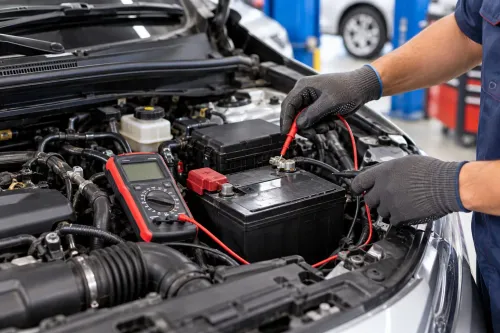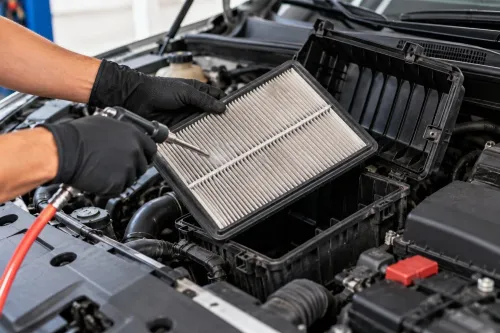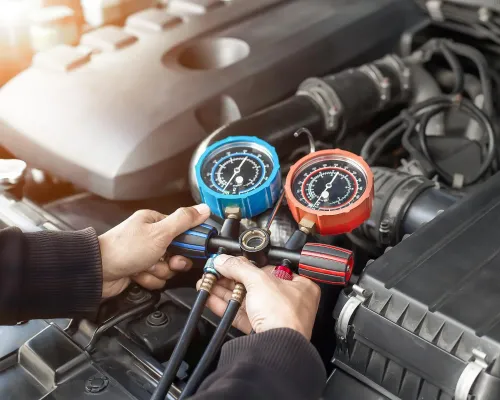
Weak cabin cooling does not automatically mean the car needs more refrigerant: a blocked filter, poor condenser airflow, electrical fault or blend-door problem can create the same complaint. You will be able to separate likely low refrigerant from those faults, understand what a proper recharge includes, and ask for evidence that the system was repaired rather than simply topped up.
Key takeaways
- Low refrigerant often causes weak cooling, but blocked airflow can feel similar.
- Ask the technician to find and repair leaks before adding refrigerant.
- Confirm whether your car uses R134a or R1234yf before service.
- Request recovered weight, recharge quantity, leak-test results, and refrigerant type.
What AC Gas Does Inside the Cooling System
Car AC gas carries heat out of the cabin; it does not create cold by itself. The compressor raises the pressure and temperature of the automotive refrigerant, then sends it through the condenser, where heat leaves the refrigerant.
An expansion device drops its pressure, and the evaporator absorbs heat from air blown through the dashboard vents. That cycle repeats while the compressor runs.
A low charge becomes a credible explanation when cooling is weak alongside signs such as:
- Cooling that improves at highway speed
- Uneven vent temperatures
- Rapid compressor cycling
- Hissing near the air-conditioning lines
- Oily residue around a hose joint or service connection
- Cooling that fades after a short period or soon after a refill
Poor cabin cooling alone does not prove low refrigerant. A blocked cabin filter, failed blower motor, dirty condenser, weak engine cooling fan, stuck blend-door actuator, faulty compressor clutch, or electrical control fault can produce the same result.
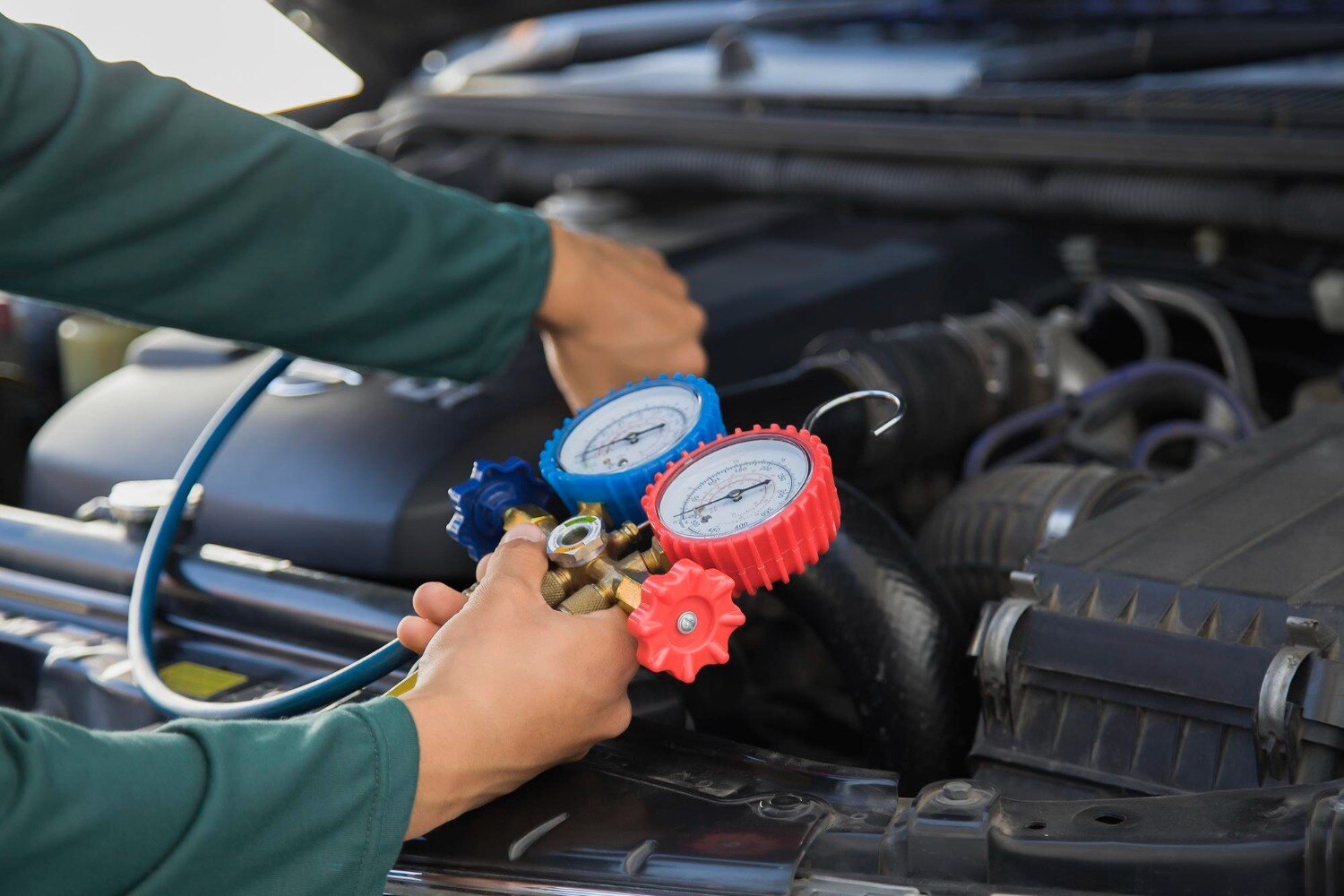
Do not decide the charge from one low-pressure or high-pressure gauge reading. Ambient temperature, engine speed, humidity, condenser airflow, compressor design, and whether the system is operating all change the reading. Refrigerant is not normally consumed, so repeated top-ups point to a leak, an earlier undercharge, or an incorrect previous repair.
Compressor oil is a separate material; adding it without the vehicle manufacturer’s specified type and quantity can reduce cooling or damage the compressor.
Symptoms That Separate Low Refrigerant from Other AC Faults
Low refrigerant symptoms usually develop gradually: cooling weakens, AC cooling fades during a drive, and the compressor may cycle rapidly. A hissing car AC after switching off, or oily residue near a hose joint, strengthens suspicion of a leak, but neither proves the charge is low.
| Symptom | More consistent with low refrigerant | Other likely explanation |
|---|---|---|
| Cooling improves at highway speed | A marginal charge can cool better with increased airflow | Failed cooling fan, blocked condenser, or heavy condenser dirt |
| Uneven vent temperature | Low charge can leave the evaporator partly starved | Blend-door fault, blocked evaporator passage, or uneven airflow |
| Rapid compressor cycling | Low suction pressure can trigger cycling | Pressure-sensor fault, evaporator icing, or electrical control problem |
| Compressor does not engage | Low pressure can command protection shutdown | Blown fuse, failed relay, wiring, clutch, compressor, or control module |
| Weak airflow with cold air | Not a strong low-charge clue | Blocked cabin filter or weak blower motor |
Evaporator icing can make cooling fade after a short period, then return after the system sits. Frost on the low-pressure line or airflow that drops while the blower still sounds normal supports icing, not an automatic need for refrigerant.
Do not treat a single gauge reading as proof. Ambient temperature, engine speed, condenser airflow, and compressor design change pressures; an accurate diagnosis compares operating pressures with vent temperature, compressor operation, airflow, and the vehicle’s specified charge.
Why Refrigerant Gets Low and What a Proper Service Includes
Refrigerant does not get consumed during normal operation. A low charge usually means an AC refrigerant leak or refrigerant lost during an earlier component repair. Common escape points include hose crimps, service valves, condenser and evaporator joints, the compressor shaft seal, and the evaporator itself.
An evaporator leak may leave no visible trace in the engine bay.
A proper service follows this order:
- Identify the refrigerant from the vehicle label and service information. R-134a and R-1234yf are different and must not be mixed.
- Perform refrigerant recovery with approved equipment instead of venting the existing charge.
- Inspect for oily residue and perform a car AC leak test using an electronic detector, compatible fluorescent dye and ultraviolet lamp, or dry nitrogen pressure testing.
- Repair the leak before recharging. A system that cools for a week and then warms again has not been fixed.
- Use a vacuum pump evacuation to remove air and moisture. A vacuum-hold result provides useful evidence, but it cannot replace positive-pressure leak testing because a system can hold vacuum and still leak when operating.
- Recharge with the manufacturer’s specified refrigerant mass, using a calibrated machine or scale, then check cooling performance and operating pressures.
Adding refrigerant from a gauge reading alone is unreliable because pressure changes with ambient temperature, engine speed, condenser airflow and compressor design. It can leave the system undercharged or overcharged.
R134a, R1234yf and the Limits of Pressure-Based Top-Ups
The vehicle’s under-bonnet refrigerant label and manufacturer service information decide whether it uses R134a vs R1234yf, not the appearance of its service fittings.
| Refrigerant | Identification | Safe service requirement |
|---|---|---|
| R134a | Older automotive refrigerant | Use equipment and oil approved for R134a |
| R1234yf | R1234yf A2L refrigerant; mildly flammable | Use dedicated, compatible recovery and charging equipment |
- Read the refrigerant label and confirm the specified charge mass and oil type in the vehicle’s service information.
- Recover the existing refrigerant instead of adding an unknown substance to it.
- Check the system for leaks and repair the cause of refrigerant loss.
- Evacuate the system with a vacuum pump to remove air and moisture.
- Perform AC charge by weight with a calibrated machine or verified scale.
- Record the refrigerant and oil quantities added.
AC gauge pressure alone cannot tell you how much refrigerant belongs in the system. The reading changes with ambient temperature, humidity, engine speed, condenser airflow, compressor design and whether the compressor is operating. A pressure-based top-up can leave the system undercharged or overcharged, even when the gauge appears normal.
Do not use an unlabelled substitute or mix R134a with R1234yf. Cross-contamination can require recovery, machine decontamination and component replacement. If the compressor will not engage, test the control circuit and pressure sensor as well; a fuse, relay, wiring, clutch or compressor fault can produce the same symptom as low refrigerant.
What to Request on the Job Card Before You Approve the Recharge
Ask the workshop to record the refrigerant identity, measured charge and leak-test findings before you approve the recharge. A pressure reading alone cannot prove the correct charge because temperature, engine speed and condenser airflow change the result.
Use this AC recharge checklist on the job card:
1. State the refrigerant specified on the vehicle label, such as R-134a or R-1234yf. Record the recovered refrigerant mass and the manufacturer’s specified refrigerant quantity in grams.
2. Record the leak checks performed and their results: visual inspection for oily residue, electronic detector, ultraviolet dye inspection or dry-nitrogen pressure testing. A note saying “no leak found” is not enough.
3. Include the evacuation time and vacuum-hold test result, including whether the vacuum held for the stated test period. This test supports the diagnosis but does not replace positive-pressure leak testing.
4. State the compressor oil type and exact quantity added, plus the reason for adding it. Do not accept “oil topped up” without a measured amount; excess oil reduces cooling and can harm the compressor.
5. Record the final refrigerant quantity charged by calibrated machine or scale, not a pressure-based top-up, and note vent temperature or operating pressures after the system runs.
Whether you use Auto Solutions or another workshop, ask for these entries before signing. They give you evidence that the cause was investigated rather than hidden under another recharge.
Frequently asked questions
What does car AC refrigerant do inside the cooling system?
Refrigerant absorbs heat from the cabin evaporator and releases it through the condenser outside the cabin.
How can you tell low refrigerant from another AC fault?
Weak cooling with correct blower airflow points toward refrigerant loss, while poor airflow points to filters, the blower, or evaporator blockage. A pressure and temperature check confirms the diagnosis.
Why does car AC refrigerant become low?
Refrigerant does not get consumed during normal operation. Low charge usually indicates a leak at a hose, O-ring, condenser, evaporator, service port, or compressor seal.
Can a workshop recharge AC gas using pressure readings alone?
No. Pressure varies with ambient temperature, compressor operation, airflow, and refrigerant type. Recovering and weighing the refrigerant, then charging the specified mass, gives a more reliable result.
What should you request before approving an AC recharge?
Ask for the refrigerant type, recovered quantity, specified charge weight, leak-test method and result, oil added, and the final cooling or pressure readings.