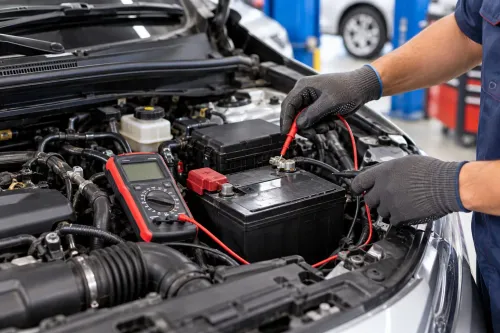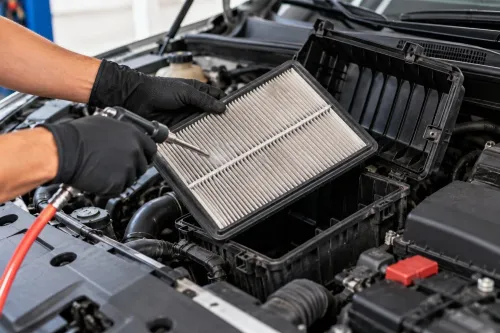

Poor acceleration can come from a contaminated mass airflow sensor, but the same hesitation, unstable idle, or check-engine light can also point to an intake leak, ignition fault, fuel problem, or transmission issue. By the end, you will know which evidence supports cleaning, which findings call for sensor replacement or another repair, and what checks to request before approving the work.
Key takeaways
- Check live MAF airflow data before approving cleaning.
- Vacuum leaks, blocked filters, and fuel faults can mimic MAF contamination.
- Use only MAF-specific cleaner and never touch the sensing element.
- Replace the sensor when testing shows an electrical or measurement fault.
How a contaminated MAF sensor changes engine behaviour
A mass airflow sensor measures the mass of air entering the engine. It uses a heated wire or heated film sensor element; incoming air cools that element, and the MAF sensor converts the change into an airflow signal. The engine control unit uses it to calculate fuel delivery and, on many engines, engine load.
Contamination can distort that signal, so the ECU supplies too much or too little fuel for the actual airflow. The result is poor acceleration, hesitation when you open the throttle, sluggish power, unstable idle, hard starting, increased fuel consumption, or an illuminated check-engine light.
| Symptom | Why contamination is plausible | What it does not prove |
|---|---|---|
| Hesitation on acceleration | The ECU receives a false airflow value during changing demand | A fuel, ignition, or intake fault can feel identical |
| Sluggish power across the rev range | Incorrect load information can restrict fueling or engine response | A clogged air filter or turbocharger fault remains possible |
| Rough or unstable idle | Small airflow errors matter most at low engine speed | An intake leak or dirty throttle body can cause the same symptom |
| Poor fuel economy | Incorrect airflow data produces an overly rich mixture | A thermostat, injector, oxygen sensor, or transmission fault can also raise consumption |
A P0100, P0101, P0102, P0103, or P0104 code identifies a MAF circuit, range, or performance problem, not dirt specifically. Cleaning helps only when dust, oil, or filter-treatment residue coats an otherwise functioning element; it cannot repair a broken heated wire, damaged film, failed electronics, or corroded connector.
Which faults can mimic a dirty MAF sensor?
A P0100–P0104 code does not prove that the MAF sensor is dirty. The same codes can result from a split intake duct, loose connector, poor ground, blocked air filter, incorrect sensor, or air entering after the sensor.
| Fault | Clue that points away from the MAF |
|---|---|
| Air filter | A visibly packed filter restricts airflow and causes poor acceleration across the rev range. |
| Intake leak | A split boot, loose clamp, or failed PCV hose often causes lean trims and unstable idle; use a smoke test. |
| Throttle body | Sticking throttle-plate movement, carbon around the bore, or inconsistent pedal response suggests a throttle fault. |
| Fuel delivery | Low fuel pressure causes hesitation, hard starting, and power loss that worsens under load. |
| Ignition | A rough engine, flashing check-engine light, or P0300–P030X misfire codes points to plugs, coils, or wiring. |
| Turbocharger | A boost leak, hissing sound, or power loss only under boost shifts suspicion to the turbo system. |
| Oxygen sensor | Slow sensor response or oxygen-sensor codes can distort fueling, but they do not prove MAF contamination. |
| Transmission | Rising engine speed without matching road speed, delayed shifts, or slipping indicates transmission trouble rather than an airflow fault. |
Compare fuel trims at idle and under load. Trims much worse at idle suggest a vacuum leak; similar positive trims in both conditions fit an under-reporting MAF or fuel shortage. If poor acceleration remains after correct cleaning, further cleaning will not fix the cause.
What diagnostic evidence separates dirt from sensor failure?
A code or low airflow reading does not prove that dirt is the cause. P0100, P0101, P0102, P0103 and P0104 identify MAF circuit, range, performance or signal faults; wiring, grounds, intake leaks, a blocked filter or the wrong sensor can trigger them too.
- Record stored and pending codes, freeze-frame data and fuel trims before touching anything. Note whether the fault appeared at idle, during acceleration or under load.
- Inspect the air filter, its seal, the intake duct and clamps for gaps or cracks. Check the MAF connector, terminals, wiring and ground. A smoke test is appropriate when unmetered air is suspected.
- Compare live MAF readings at hot idle and through a controlled acceleration with the vehicle manufacturer’s specifications or a known-good comparison. A stable signal that rises smoothly with engine speed supports a wiring and sensor signal that are functioning; an implausible, fixed or erratic signal points toward a fault.
- Read short-term and long-term fuel trims under the same conditions. Similar positive trims at idle and under load support an under-reporting MAF after leaks and fuel faults are excluded. Trims that become much more positive at idle point more strongly to a vacuum leak.
Visible dust supports cleaning only when the electrical checks and readings remain plausible. A damaged sensing element, missing seal, failed circuit or unchanged data after cleaning calls for sensor replacement or further diagnosis, not repeated cleaning.
Do not disconnect the battery unless the service procedure requires it; doing so can erase evidence and reset readiness monitors.
When is MAF cleaning safe, and when can it make things worse?
Cleaning is appropriate when inspection finds a removable coating of dust, oil, or air-filter treatment on an otherwise intact sensing wire or sensing film. It is the wrong repair for physical damage, electronic failure, or contamination that has entered the sensor housing.
| Condition | Cleaning decision | Why |
|---|---|---|
| Visible dust, oil film, or filter-oil residue on an intact element | Clean carefully | The deposit can distort airflow measurement |
| Bent or broken sensing wire, cracked sensing film, or burnt element | Replace the sensor | Solvent cannot restore the measuring element |
| Water intrusion, corrosion, damaged terminals, or a loose connector | Repair the cause or replace the sensor | Moisture and electrical damage are not removable dirt |
| Cracked housing or damaged seal | Replace the damaged part | Unmetered air can enter after reassembly |
Use only MAF sensor cleaner. Switch the ignition off, remove or expose the sensor according to the vehicle’s service instructions, and spray the sensing area without touching it. Never brush, wipe, scrape, or blow the element with high-pressure air; a wire can break or a thin film can lose accuracy while still looking normal.
Allow the solvent to evaporate completely before refitting the sensor. Keep cleaner away from a running engine and do not spray while the sensor is electrically powered. Reinstall it with the original seal seated correctly and the airflow arrow pointing toward the engine.
Carburetor, throttle-body, brake, petroleum, and oily contact cleaners can attack plastic, leave residue, or change heat transfer.
What should you ask a workshop to check before approving MAF cleaning?
Approve cleaning only after the workshop shows evidence that contamination is the likely cause, not merely because acceleration is poor or a code is stored.
1. Ask for a visual inspection of the air-filter element, air-filter housing seal, intake duct, clamps, hoses, and crankcase-ventilation connections. A split boot or loose clamp can admit unmetered air and imitate a dirty sensor.
2. Request checks of the sensor connector, wiring, power supply, and ground. Codes P0100–P0104 identify MAF circuit or performance faults, not dirt alone; a blocked filter, wiring fault, poor ground, or incorrect sensor can trigger them.
3. Have the technician record live MAF readings at idle and during acceleration, alongside short- and long-term fuel trims. The pattern matters more than one implausible number.
4. If the trims or inspection indicate an intake-air leak, require a smoke test before approving cleaning. Smoke escaping between the MAF housing and throttle body identifies a fault cleaning cannot cure.
Auto Solutions can document these readings and inspect the intake path before treating the sensor.
Stop pursuing cleaning when the sensor has physical damage, the signal remains implausible after cleaning, or the engine still runs poorly with correct wiring and no leak. Investigate fuel delivery, ignition, throttle, turbocharger, or the wrong sensor-and-housing combination instead.
Frequently asked questions
How does a contaminated MAF sensor affect engine behaviour?
Contamination can distort the airflow signal, causing poor acceleration, hesitation, rough idling, hard starting, or increased fuel consumption.
Which faults can mimic a dirty MAF sensor?
Vacuum leaks, split intake hoses, a blocked air filter, throttle-body deposits, ignition faults, fuel-delivery problems, and exhaust restrictions can produce similar symptoms.
What diagnostic evidence separates dirt from MAF sensor failure?
Ask for stored fault codes, live MAF readings, intake inspection results, electrical supply and ground tests, and comparison with expected airflow for the engine.
When is MAF cleaning safe, and when can it make things worse?
Cleaning is appropriate when the sensor is contaminated and its wiring and readings are sound. Wrong solvents, compressed air, or contact with the sensing element can damage it.
What should you ask a workshop to check before approving MAF cleaning?
Ask the workshop to inspect the air filter and intake hose, test for vacuum leaks, verify wiring and live data, and explain why cleaning is preferable to replacement.