A brief squeal after rain is different from grinding, just as ABS pulsation during a hard stop is different from vibration every time you brake. You will learn how to trace each symptom, recognise conditions that make driving unsafe, and know what a proper inspection must measure before parts are replaced.
Key takeaways
- Surface rust after rain should fade after several normal stops.
- Steering-wheel vibration points to front brakes; pedal pulsation points to brake hydraulics.
- A sinking pedal, pulling, or longer stopping distance requires prompt inspection.
- Stop driving if metal-on-metal grinding, brake fluid loss, or weak braking occurs.
When brake noise is harmless—and when it means metal is grinding
A brief high-pitched brake noise after rain or overnight parking is often surface moisture and light rust. It should fade after several normal stops. Dust or a small stone between the pad and rotor can also create temporary brake squealing without indicating a worn component.
Persistent brake squealing has several possible causes: a pad wear indicator touching the rotor, pad vibration against the caliper or shims, contamination, or friction material that has become hardened by heat. Glazed brake pads and rotors can squeal while still appearing thick, so noise alone does not prove the pads need replacement.
| Sound | What it can mean | Action |
|---|---|---|
| Brief squeak that disappears after braking | Moisture, light rust or dust | Monitor it if braking feels normal |
| Repeated high-pitched squeal | Wear indicator, pad vibration, contamination or glazing | Arrange a brake inspection soon |
| Harsh scraping or metal-on-metal grinding | Worn brake pads exposing their backing plate, or severe rotor damage | Stop driving and arrange roadside recovery |
Do not treat grinding as a routine inspection issue. Continuing to drive can destroy the rotor, reduce braking friction and damage the caliper. Stop immediately if the sound is accompanied by a sudden loss of braking, a brake warning light, pulling, or a pedal that reaches unusually close to the floor.
A squeal deserves diagnosis; grinding demands action.
Use the vibration location to narrow the fault
The location of the shake narrows the search, but it does not identify a failed part by itself. Note whether it appears only under braking, at a particular speed, or during ABS activation.
- Brake-pedal vibration during ordinary dry-road braking points toward uneven hydraulic force or rotor contact. Disc thickness variation, commonly described as warped brake rotors, can push the pads and caliper piston back as the rotor turns. A pedal pulse only during a hard stop on a slippery surface is usually ABS pressure modulation.
- Steering-wheel vibration that starts mainly when you brake is consistent with a front-brake issue, including rotor runout or disc thickness variation. Wheel installation, hub runout, tyre damage, wheel imbalance, worn suspension parts and a failing wheel bearing can create a similar shake.
- Vibration through the seat, floor or vehicle body points more toward the rear brakes, a seized caliper, a damaged tyre or wheel, or driveline and suspension movement. It does not prove that the rear rotors are at fault.
Ask for measurements rather than a visual verdict. A technician should check rotor lateral runout and thickness against the vehicle maker’s limits, then inspect wheel fitment, hubs, calipers, tyres, bearings and suspension. Do not approve resurfacing or replacement solely because a rotor looks discoloured or feels uneven.
How to recognise a real change in stopping performance
A real change in stopping performance means the car needs more pedal effort, more pedal travel, or more road to stop. Compare the same route only under similar speed, load, tyre pressure and road conditions; never test emergency braking in traffic.
Repeatedly pumping the pedal to restore firmness points to a hydraulic fault, not a normal brake characteristic.
| Symptom | Brake-related clues | Other systems that can mimic it |
|---|---|---|
| Longer stopping distance | Brake fade, glazed pads or rotors, contaminated friction surfaces, low hydraulic pressure, or ABS faults | Worn or underinflated tyres, wet or loose road surface, heavy load, high speed, cold brakes, or delayed driver reaction |
| Soft or spongy brake pedal | Air or vapour in the lines, expanding hose, contaminated fluid, or a hydraulic leak | ABS control faults can alter pedal feel |
| Low firm brake pedal | Excessive pad or shoe clearance, rotor runout, or a master-cylinder fault | Incorrect adjustment or mechanical movement elsewhere in the pedal linkage |
| Brake pulling to one side | Unequal hydraulic pressure, a sticking caliper, seized slide, or restricted hose | Unequal tyre pressure, tyre conicity, poor alignment, worn suspension, or a failing wheel bearing |
A falling fluid level, visible leak, or sudden change in pedal height is a safety issue. The red brake warning lamp can indicate an engaged parking brake, low fluid or a hydraulic problem; the ABS lamp commonly means anti-lock control is disabled while conventional braking remains.
Check the handbook and obtain a diagnostic scan rather than guessing.
Know when to stop immediately instead of driving to a workshop
Recover the car instead of driving when the pedal goes soft, sinks while held, or needs repeated pumping to stop. Do the same for a brake fluid leak, brake grinding and smoke, a wheel that pulls sharply, or braking that becomes dangerously weak. These faults can worsen between your driveway and the workshop.
| Symptom | Action | Why |
|---|---|---|
| Red brake-warning light, especially with low fluid or a soft pedal | Roadside recovery | It can indicate hydraulic failure, not just an engaged parking brake |
| ABS-warning light alone, with a firm pedal and normal stopping | Carefully controlled short drive | Anti-lock control may be disabled while conventional braking remains |
| ABS-warning light with the red brake-warning light | Roadside recovery | The combination can indicate a wider brake-system fault |
| Grinding, smoke, burning smell, or a wheel too hot to touch | Roadside recovery | A seized caliper or destroyed friction material can cause rapid damage or loss of braking |
| Mild squeal or vibration with normal pedal firmness and straight tracking | Short drive for diagnosis | The car still responds predictably, but the fault needs prompt inspection |
For a permitted short drive, choose a dry, low-traffic route, keep speed down, leave extra following distance, and avoid hills or heavy loads. Stop immediately if the pedal changes, the car pulls, the warning lights change, or braking takes more effort.
A brake pedal pulsing during ordinary dry-road braking is not normal ABS operation; arrange diagnosis rather than testing it repeatedly.
What a proper brake inspection should check and measure
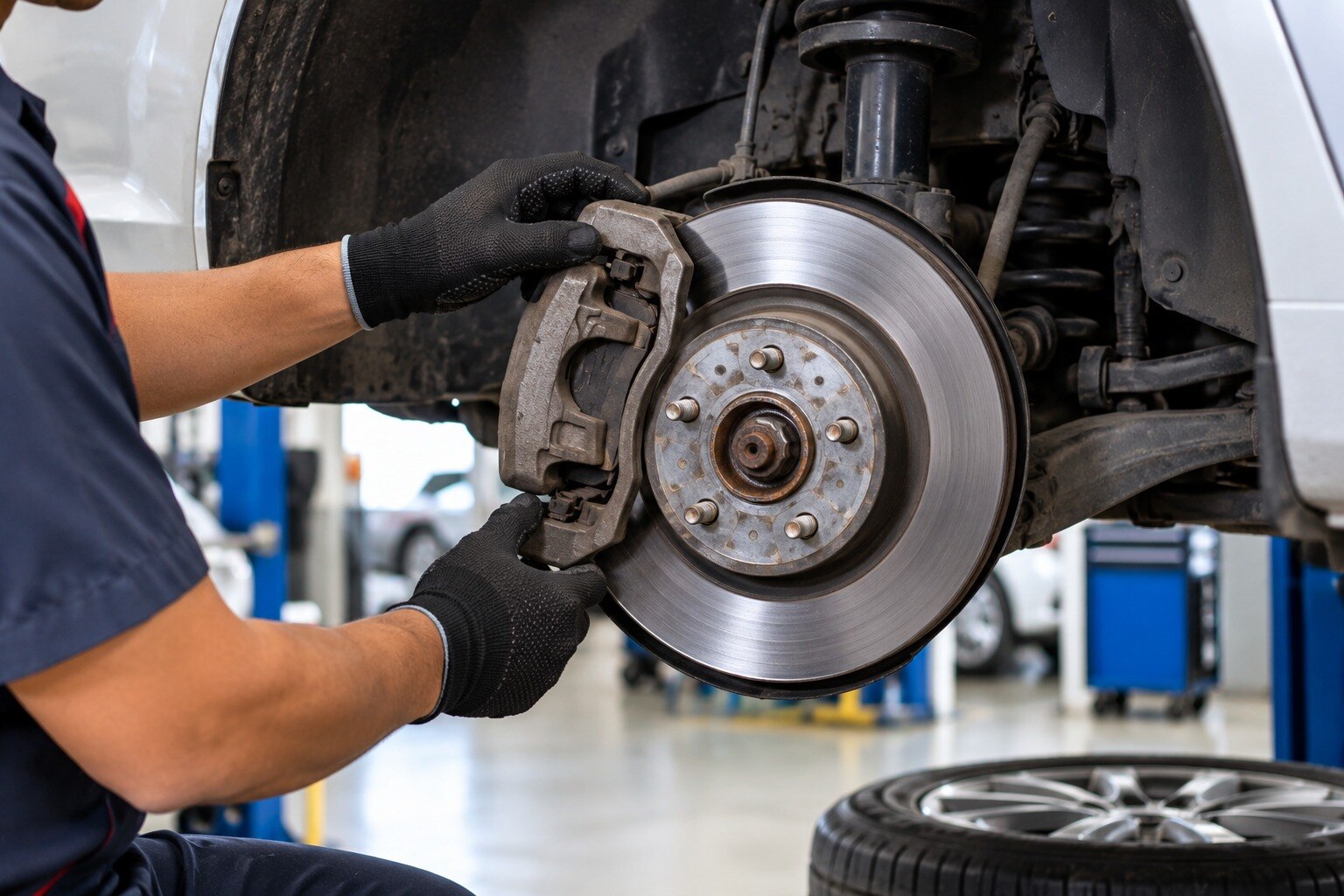
A wheel-through-spokes glance cannot reliably establish brake condition. A proper inspection may require removing the wheel, cleaning measurement points and comparing results with the vehicle manufacturer’s limits, including the rotor discard specification.
Ask the technician to document these checks:
- Measure brake-pad thickness on both sides of each axle and explain uneven wear. Replace pads as an axle set, then correct seized guide pins, a sticking piston, restricted hose or incorrect hardware before fitting them.
- Measure rotor thickness and runout, including disc-thickness variation, and check hub runout, wheel installation, suspension and tyre condition. Resurface or replace the rotor only when measurements fall outside limits; appearance alone is not enough.
- Check caliper operation and hoses for restricted flow, leaks, damaged flex sections and uneven piston or guide-pin movement.
- Test brake-fluid condition and inspect the master cylinder, hydraulic lines, ABS warning system and fluid level. Recommend fluid service against the maker’s fluid specification, maintenance schedule and measured condition—not a universal mileage interval.
Arrange a same-day inspection if stopping distance has increased, the pedal feels soft, you must pump it, the car pulls, or a brake warning lamp stays on. A new squeal or vibration without those changes still deserves an appointment within the next few days.
At Auto Solutions, ask for the measured pad and rotor values rather than accepting “looks worn” as the diagnosis.
Frequently asked questions
When is brake squealing harmless, and when does it indicate damage?
A brief high-pitched squeal after rain or overnight parking can come from surface moisture and light rust. Persistent noise, scraping, or metal-on-metal grinding needs inspection.
What does brake vibration location reveal?
Vibration through the steering wheel usually points to a front brake or wheel issue. Pulsation through the brake pedal points to a brake rotor or hydraulic problem.
How can you recognise a real change in stopping performance?
Watch for a longer stopping distance, a soft or sinking pedal, pulling to one side, repeated pumping, or the need for greater pedal pressure.
When should you stop driving instead of going to a workshop?
Stop immediately if braking is weak, the pedal reaches the floor, brake fluid is leaking, or you hear metal grinding.
What should a proper brake inspection measure?
The inspection should check pad thickness, rotor thickness and runout, caliper movement, brake-fluid condition, leaks, hose condition, tyre grip, and braking performance.